Any Salesforce cost estimator is a model. Whether to trust one depends less on the number it shows than on whether it shows how it got there. We built ours with the working visible. This article explains how, including the mistakes we found and the things it deliberately does not do.
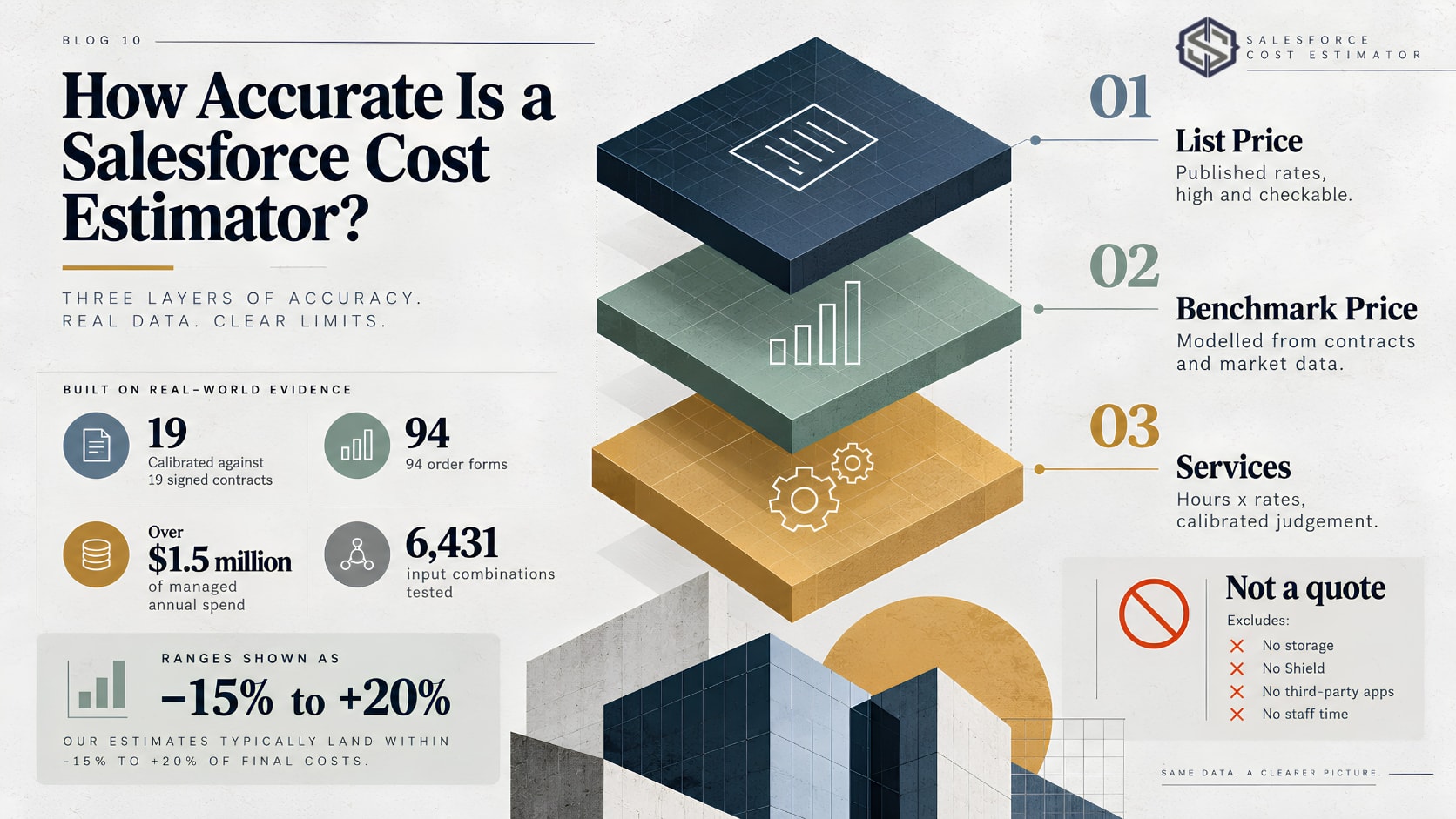
- An estimate has three layers of different accuracy: published list prices (checkable), benchmark discounts (modelled from contracts) and services hours (calibrated judgement).
- Ours is calibrated against 19 signed contracts, 94 order forms and over $1.5 million of managed annual spend, and ranges are shown as minus 15% to plus 20%.
- We tested about 6,431 input combinations for impossible results such as negative totals or a benchmark above list price.
- It is an estimate, not a quote. It does not model storage, Shield, third-party apps or your own staff time.
Three layers, three kinds of accuracy
When people ask whether an estimator is accurate they usually mean the final number. But that number is the sum of three very different things.
| Layer | What it is | How accurate | How we handle it |
|---|---|---|---|
| List price | Salesforce's published rates per edition, add-on and licence | High, and checkable. Changes when Salesforce changes pricing | Verified on a dated basis (29 September 2026) and shown on the page and in the PDF |
| Benchmark price | What organisations like you typically pay after negotiation | Moderate. Depends on your negotiation, term and timing | Factors by size from contracts and market data; shown beside list, not instead of it |
| Services | Hours multiplied by a delivery rate | Moderate to low for unusual projects | Hours by band and scope, 15% contingency, ranges, and a cross-check against licences |
Showing list and benchmark side by side is deliberate. If we showed only the discounted figure you would have to trust our negotiating assumption. With both, you can see the ceiling, the target and the difference.
Where the numbers come from
- Published list prices for commercial CRM, Nonprofit Cloud, industry clouds, marketing, commerce, Platform, Tableau and add-ons.
- The Salesforce for Nonprofits pricing guide (2026) and official Experience Cloud rate cards for portal licences.
- Our own contracts: 19 signed contracts and 94 order forms covering over $1.5 million of annual spend, which supply observed prices for add-ons and nonprofit discounts.
- Market data on discounts by deal size, because the new editions have no signed history yet.
For the new Core, Advanced and Max tiers, which launched on 3 September 2026, we apply typical discounts for your size and say plainly in the results that these are indicative. Our renewal guide shows the factors.
How we test it
A calculator can look right on three examples and fail on the fourth, so we test the whole input space. We ran about 6,431 combinations of organisation type, team size, outcomes, portal use, data sources, integrations, process fit, support, timeline, pricing lineup and delivery model, checking for impossible outputs: not-a-number values, negative totals, a benchmark above list, or a year one smaller than its own licences. None remained at release.
We also keep a set of regression scenarios, such as a 15-person nonprofit and a 50-person business, and re-run them after every price change. A change in one price should move only the scenarios that use it.
What we got wrong, and fixed
Anyone building an estimator makes mistakes. Ours were instructive:
- Implementation was about twice too high. Early versions used fixed dollar amounts, some double-counted. We rebuilt it as hours times rate and checked it against known ranges for migration, integration, portals and training.
- Tableau was compared on the wrong edition. We were comparing Standard prices with Enterprise list. Now both sides use Tableau Cloud Standard.
- Bundled items were charged twice. Agentforce and Tableau Next are bundled in Core and above, so they are no longer added on top.
- Sandboxes were charged when included. We added entitlements: Partial Copy in Core and above, Full Copy from Advanced up.
- Portal pricing came from one unverified source. An expert pointed out that login-based cost looked high. We replaced it with official rates. See Experience Cloud pricing.
We list these because a tool that says it has never been wrong is not credible.
How to read an estimate without being misled
Take the 50-person business from our budget examples: Year 1 at list of about $179,900 and at benchmark of about $156,500, with a range of roughly $133,000 to $188,000 around the benchmark. Three readings are worth making. The benchmark is the realistic target, list is the ceiling you would pay without negotiating, and the range tells you the number is a planning figure, not a promise. If a real quote lands outside the range, that is not proof the tool is wrong or the quote is wrong, it is a prompt to find out what differs: scope, edition, discount or hours.
Why we show ranges
Every central figure comes with a range of minus 15% to plus 20%. The asymmetry is intentional, since scope grows more often than it shrinks. Treat the range as honest uncertainty, not as a negotiation margin.
What it deliberately does not do
- It is not a quote and does not replace a conversation with Salesforce.
- It does not forecast usage-based charges for Tableau or Data Cloud, though it flags them.
- It does not model extra data storage, Shield, third-party apps or your own staff time. Our hidden costs checklist covers those.
- It uses the same hours for every delivery model, so it understates coordination effort on some offshore projects. See offshore vs onshore.
- Industry cloud prices for the new lineup were not published at verification, so current industry prices are shown and labelled.
Five questions to ask any estimator
- Does it show list and negotiated pricing separately?
- Does it explain why each line is there, and what it left out?
- Does it show hours and rates for services, or only a lump sum?
- Does it state when prices were last verified?
- Does it admit what it does not model, and show a range?
You can judge ours against those questions in about two minutes. Open the Salesforce Cost Estimator, or read How much does Salesforce cost in 2026? for three worked budgets.
Frequently asked questions
How accurate is a Salesforce cost estimator?
It depends on the layer. List prices can be checked against Salesforce's published rates. Discounts are modelled and vary by negotiation. Implementation hours are judgement calibrated on past projects. A good estimator is accurate enough to compare options and test a quote, and says so honestly.
Is the TwinStack Salesforce cost estimator a quote?
No. It is an estimate and shows a range of minus 15% to plus 20% around the central figure. Actual pricing depends on negotiation, term, volume and region, and excludes sales tax.
Where do Salesforce cost estimator benchmark prices come from?
From 19 signed contracts and 94 order forms covering more than $1.5 million of annual spend, plus market data on discounts by deal size. For the new Core, Advanced and Max editions, launched on 3 September 2026, there are not yet signed contracts, so benchmarks use typical discounts and are labelled indicative.
What does the TwinStack Salesforce cost estimator not include?
Sales tax, extra data storage, Shield and event monitoring, third-party AppExchange subscriptions, usage overage on Tableau and Data Cloud, and the time your own staff spend. It flags the usage items, but it does not forecast them.
How should I compare a Salesforce cost estimate with a real quote?
Line-item the quote against it. Check which items are bundled, which sandboxes are included, whether the number of licences matches your real users, and whether implementation hours are visible. Differences become specific questions.
What ranges does the TwinStack Salesforce cost estimator show?
Every central figure comes with a range of minus 15% to plus 20%. The range is asymmetric on purpose, because scope grows more often than it shrinks.
Prices in this article are Salesforce list prices in US dollars, per user per month billed annually unless stated, as verified on 29 September 2026. Salesforce changes pricing, so confirm with Salesforce before you sign. Figures marked "estimator" come from the TwinStack Cost Estimator and are estimates, not quotes.
Judge it for yourself
Run an estimate, read the reasoning behind each line, and compare it with any quote you hold. A free call is available if you want a person to check it.