
We are an offshore Salesforce partner, so you should read this with that in mind. We also build the estimator that shows our own numbers beside the alternatives, which means we have an interest in being fair. Here is what the rate difference buys, what it risks, and when we would send you elsewhere.
- The same 25-user project costs $53,511 in year-one services at $65 an hour, $74,093 at $90, $144,069 at $175 and $288,138 at $350.
- Over three years, the total runs from about $231,000 offshore to about $534,000 with a global integrator.
- The estimator holds hours constant across models. Real offshore projects can need more communication and review, so add a buffer or price nearshore as a midpoint.
- Hybrid delivery, with a senior onshore architect and an offshore build team, is often the best compromise.
Four delivery models, four rates
| Model | Rate in our estimator | Who it is for |
|---|---|---|
| Offshore (TwinStack Dhaka) | $65 per hour | Cost-sensitive teams, nonprofits, small and mid-sized builds |
| Nearshore | $90 per hour | Teams that want time-zone overlap at a lower price than onshore |
| Onshore US or UK | $175 per hour | On-site workshops, local-law needs, same-timezone collaboration |
| Big 4 or global integrator | $350 per hour | Large multi-country programmes needing heavy governance |
Rates are estimator assumptions as of 29 September 2026 and vary by supplier, seniority and region.
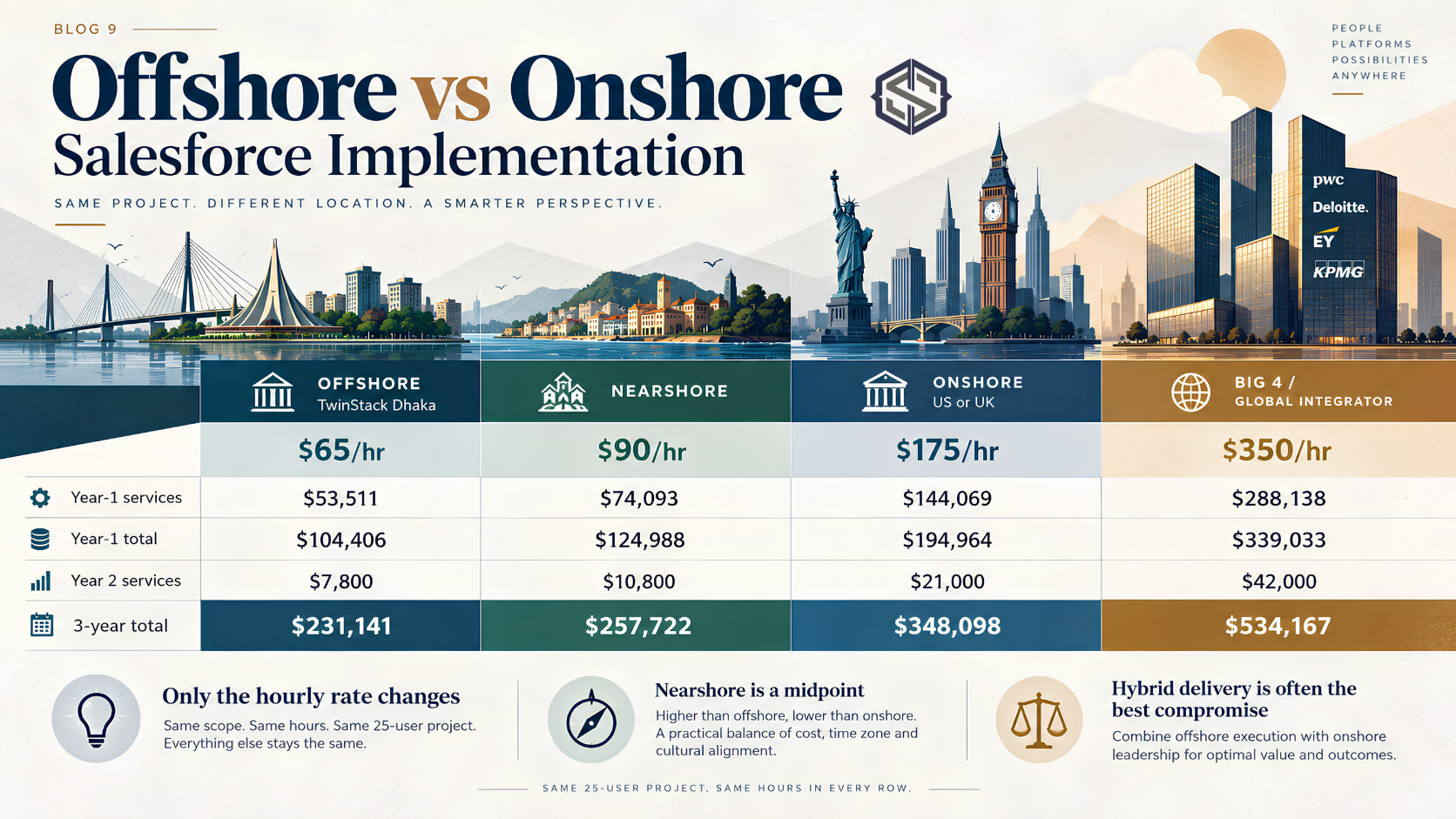
The same project, priced four ways
Take a 25-person business on Sales and Service Core. It migrates from spreadsheets, builds one integration, trains its team, goes live in four to six months and keeps a small support block. The licence bill is $50,895 a year at benchmark pricing and does not change with the delivery model. Only the price of an hour changes.
| Delivery model | Year-1 services | Year-1 total | Year 2 services | 3-year total |
|---|---|---|---|---|
| Offshore, $65 | $53,511 | $104,406 | $7,800 | $231,141 |
| Nearshore, $90 | $74,093 | $124,988 | $10,800 | $257,722 |
| Onshore, $175 | $144,069 | $194,964 | $21,000 | $348,098 |
| Global integrator, $350 | $288,138 | $339,033 | $42,000 | $534,167 |
TwinStack Cost Estimator, 29 September 2026 data. Same hours in every row.
The gap between offshore and onshore is $90,558 in year one and $116,957 over three years. The gap to a global integrator is more than $234,000 in year one. That is the headline. The question is what, if anything, those premiums buy.
The case for offshore
- The arithmetic. A $65 rate leaves room for a larger scope, more testing or a longer support period for the same money.
- Mature talent pools. Bangladesh, India and Eastern Europe all have experienced, certified Salesforce engineers.
- Suits phased delivery. A well-run project with written requirements and weekly demos does not need everyone in one room.
The case for onshore
- Proximity. If your organisation values in-person workshops, an onshore team is easier to put in a room.
- Legal and compliance comfort. Some regulated sectors require local contracts or data handled in-region.
- Time zone. A same-day answer to a question is worth a lot during a go-live week.
The honest risks of offshore, and how to manage them
| Risk | What helps |
|---|---|
| Time zone gaps slow decisions | Agree at least two hours of daily overlap and a single decision-maker on your side |
| Requirements lost in translation | Write acceptance criteria and demo every week |
| Uneven vendor quality | Ask for named architects, certifications and a reference client of your size |
| Data handling concerns | Give access through your own Salesforce org and sandboxes with least-privilege permissions, and review access with a tool such as Who Sees What |
| Hours creeping up | Fixed scope per phase and a change-control process |
One caution about our own numbers. The estimator uses the same hours for every delivery model, so it understates the extra coordination effort some offshore projects need. If that worries you, price the nearshore rate as a midpoint: $74,093 in year one for this example, still about half of onshore.
What to ask any offshore Salesforce vendor
- Who exactly will work on my project, and what Salesforce certifications do they hold?
- Which hours overlap with my working day, and who answers questions outside them?
- How are requirements written, and what counts as accepted work?
- Which sandbox will you build in, and how do you protect production data?
- Can I speak to a client of a similar size and sector?
- What happens after go-live, and what does support cost?
A vendor who answers these concretely is worth considering at any rate. One who cannot is expensive even at $65.
The hybrid that often wins
Many organisations split the work: a senior onshore architect owns design, stakeholder workshops and acceptance, while an offshore team builds, tests and supports. You pay onshore rates only for the hours where proximity matters, and offshore rates for the rest. It is not a formal option in the estimator, but you can approximate it by pricing both models and blending by hours.
A simple decision guide
| If this is true | Lean toward |
|---|---|
| Under 100 users, standard or moderately custom processes, a limited budget | Offshore or nearshore |
| A regulated sector, strict data residency or political sensitivity | Onshore, or hybrid with strong controls |
| Multi-country rollout with formal programme governance | Global integrator for governance, with offshore build underneath if allowed |
| A nonprofit funded by a grant for capacity building | Offshore, with a small support retainer |
The rate is only one input. Compare the whole model: scope, hours, the people who will do the work, and what happens after go-live. See What does a Salesforce implementation cost? for the hours behind each rate, and small business pricing for how this plays out at five to ten users. When you are ready, run your own estimate.
Frequently asked questions
Is offshore Salesforce implementation cheaper?
Per hour, yes: $65 against $175 onshore in our model. For a 25-user project that is about $53,500 against about $144,100 in year-one services. The saving is real if the offshore team has the same capability and the project is well governed.
What are the risks of offshore Salesforce delivery?
Time zone gaps, communication overhead, uneven quality between vendors, data handling concerns and weaker alignment with your internal team. All can be managed with a named architect, overlap hours, written specifications, demos each sprint and clear access controls.
When should I choose an onshore Salesforce partner?
When you need in-person workshops, strict data residency, same-timezone collaboration for a highly regulated or politically sensitive project, or when your leadership demands a local contract. The higher rate pays for proximity.
What is nearshore Salesforce delivery?
A delivery team in a nearby country or similar time zone, typically priced between offshore and onshore. We model it at $90 an hour, giving about $74,100 of year-one services in our 25-user example.
Do I need a Big 4 or global integrator for Salesforce?
Rarely for a team under 100 users. Their rate of about $350 an hour buys programme governance and scale, which large, multi-country transformations need. For a small or mid-sized organisation it means paying more than five times the offshore price for the same hours.
What is hybrid Salesforce delivery?
A senior onshore architect owns design, stakeholder workshops and acceptance, while an offshore team builds, tests and supports. You pay onshore rates only for the hours where proximity matters, and offshore rates for the rest.
Prices in this article are Salesforce list prices in US dollars, per user per month billed annually unless stated, as verified on 29 September 2026. Salesforce changes pricing, so confirm with Salesforce before you sign. Figures marked "estimator" come from the TwinStack Cost Estimator and are estimates, not quotes.
Switch the delivery model and watch the total move
Choose offshore, nearshore, onshore or global integrator in the estimator and see year one and three-year totals update.