Ask three partners for a Salesforce quote and you may get three numbers that differ by a factor of four. It is not random. Implementation cost is hours multiplied by an hourly rate, and once you can see both, you can compare quotes properly instead of guessing which one is wrong.
- Implementation = hours x rate x a timeline factor, plus 15% contingency. The hours come from build size, team size and the extras you add.
- Build bands run from about 150 hours (QuickStart) to 1,800 hours (enterprise). Team size scales them by 0.8 to 1.8.
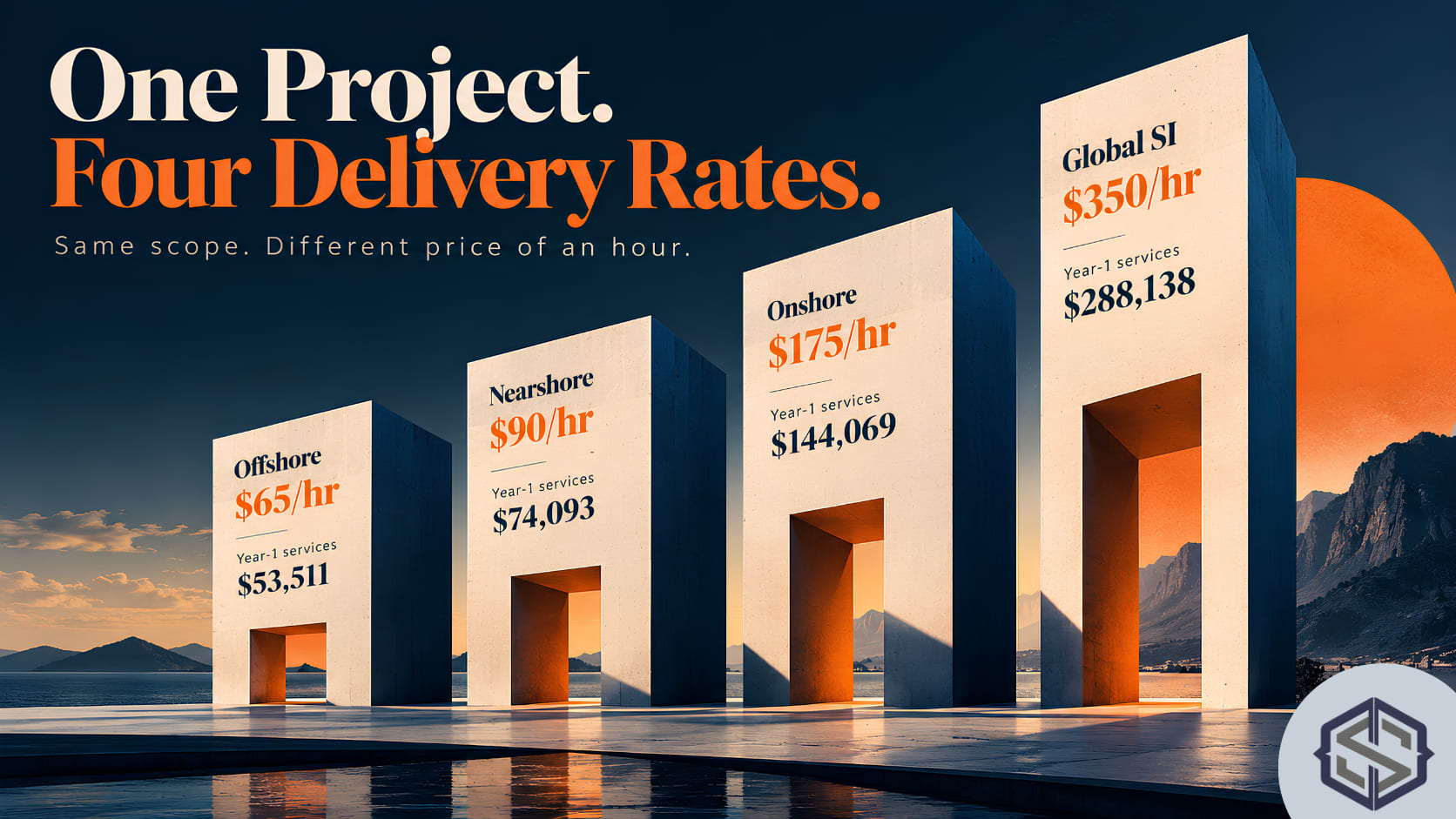
- The same 25-user project costs about $53,500 in year-one services at $65 an hour, $74,100 at $90, $144,100 at $175 and $288,100 at $350.
- A rushed three-month go-live adds a 25% premium. In our example that is about $13,500.
The formula behind every implementation quote
Strip away the proposal formatting and a Salesforce implementation quote reduces to one equation: hours x hourly rate x a timeline factor, plus a contingency, plus any recurring support. Partners who quote a fixed fee have simply done the multiplication and rounded. If a quote cannot be unpacked into hours, ask for the hours.
Build size: four bands
The biggest line is the core build: configuring the data model, automation, page layouts, reports and permissions. We group projects into four bands, each with a base number of hours.
| Band | Base hours | Typical duration | What it looks like |
|---|---|---|---|
| QuickStart | 150 | 2 to 6 weeks | Mostly configuration of standard features |
| Standard | 400 | 6 to 12 weeks | One cloud with tailoring, key automations, reports and permissions |
| Mid-market | 900 | 3 to 6 months | Custom data model, cross-team automation, integrations, sandbox testing |
| Enterprise | 1,800 | 6 to 12 months | Multi-part programme with several integrations, a portal and phased releases |
Base hours are for a team of 25 to 50. They are scaled by team size.
Team size scales the hours: 0.8 for 10 users or fewer, 1.0 up to 50, 1.4 up to 150 and 1.8 beyond. The band itself is not chosen by headcount. It comes from how many outcomes you want, how unusual your processes are, whether you need an industry cloud, commerce or custom apps, and how complex your integrations are.
The lines that sit around the build
| Item | Hours | Notes |
|---|---|---|
| Data migration | 90 spreadsheets, 200 another CRM, 450 several systems | Starting from scratch costs nothing |
| Integrations | 120 per standard connection, 500 per enterprise connection | Accounting, website, payments, and so on |
| Experience Cloud portal | 250 occasional use, 450 regular use | See our portal pricing guide |
| Training | 30 + 0.6 per user, capped at 120 | Admin and end-user sessions |
| Contingency | 15% of the above | Scope always moves |
| Support after go-live | 10, 40, 80 or 160 hours a month | Block, fractional, managed service, dedicated |
Each line is hours, and each can be challenged. If somebody tells you migration needs 450 hours for a single spreadsheet, the conversation writes itself.
One project, four delivery rates
Take a 25-person business with a sales and support team, a spreadsheet migration and one standard integration, going live in four to six months. Same hours, four different people doing the work:
| Delivery model | Rate per hour | Year-1 services | Year-1 total (with licences) | 3-year total |
|---|---|---|---|---|
| Offshore (TwinStack Dhaka) | $65 | $53,511 | $104,406 | $231,141 |
| Nearshore | $90 | $74,093 | $124,988 | $257,722 |
| Onshore US or UK | $175 | $144,069 | $194,964 | $348,098 |
| Big 4 or global integrator | $350 | $288,138 | $339,033 | $534,167 |
TwinStack Cost Estimator, 29 September 2026 data. Sales + Service Core, 25 users, benchmark licences of $50,895 a year. Services include 15% contingency and about seven months of 10-hours-a-month support.
The licence bill is $50,895 a year in every row. The only thing that changes is the price of an hour. At a global integrator the same work costs more than five times what it does offshore. We discuss when each is justified in offshore vs onshore Salesforce implementation.
A sanity check: implementation against licences
A widely used rule of thumb says implementation costs 1.5 to 3 times your annual licence bill at onshore rates. In the example, implementation at $175 an hour (excluding support) is about $131,800, which is 2.6 times the $50,895 licence bill. That sits inside the band. If a quote implies five or six times, either the scope is unusual or the rate is high. If it implies half, something is missing.
What makes a quote balloon
- Unique processes. Telling us your processes are unusual adds up to four points to the build score and often moves a project up a band. Ask whether each exception is a real requirement or habit.
- Enterprise integrations. A single enterprise connection is 500 hours, more than a whole QuickStart.
- A rushed date. A go-live in three months or less carries a 25% premium. In the example that raises year-one services from $53,511 to $67,052, about $13,500.
- An unowned system. If nobody will run Salesforce after launch, plan a managed service. It is cheaper than a failed rollout.
Seven questions to ask any implementation partner
- How many hours is each line of this quote, and at what rate?
- Which outcomes are in phase one and which are deliberately out?
- What is assumed about data quality and who cleans the data?
- Who tests, and in which sandbox type?
- What does support cost after go-live, and for how many months is it included?
- How is scope change priced?
- Can we talk to a client of a similar size?
Small teams should also read Salesforce pricing for small business, where licences are a tiny share of year one. To price your own project, start the estimator and open the services step.
Frequently asked questions
How much does a Salesforce implementation cost?
It depends on scope and who delivers. For a small team a QuickStart build is around 120 to 150 hours. A standard single-cloud build is about 400 hours, a mid-market programme about 900, and an enterprise programme about 1,800. Multiply by an hourly rate of $65 offshore, $175 onshore or $350 for a global integrator, then add migration, integrations, training and 15% contingency.
Why is Salesforce implementation so expensive?
Because it is skilled labour, not software. Data modelling, automation, security design, migration and testing take weeks of senior time. The cost looks high next to licences for small teams because licences are billed per seat while the build is largely fixed.
How long does a Salesforce implementation take?
A QuickStart takes 2 to 6 weeks, a standard build 6 to 12 weeks, a mid-market build 3 to 6 months and an enterprise programme 6 to 12 months. Compressing the timeline raises the price.
What is a normal ratio of implementation to licence cost?
A common rule of thumb is 1.5 to 3 times the annual licence bill at onshore rates. Free or donated licences, as in Power of Us, make the ratio look larger because the rule assumes every licence is paid for.
How can I reduce Salesforce implementation cost?
Yes. Clean your data before migration, limit the first phase to a few outcomes, accept standard processes where you can, choose a delivery model that fits the risk, and avoid a rushed go-live date.
How much does a rushed Salesforce go-live cost?
In our estimator a go-live in three months or less carries a 25% premium on services. In the 25-user example that raises year-one services from $53,511 to $67,052, about $13,500 more.
Prices in this article are Salesforce list prices in US dollars, per user per month billed annually unless stated, as verified on 29 September 2026. Salesforce changes pricing, so confirm with Salesforce before you sign. Figures marked "estimator" come from the TwinStack Cost Estimator and are estimates, not quotes.
See the hours behind your own quote
The estimator shows every service line as hours times rate, so you can compare it with a partner's proposal.