Most Salesforce renewals are won or lost months before the paperwork. The customers who pay close to list usually did one thing: they waited for the renewal notice. The ones who pay well below it prepared a number, a deadline and a few alternatives. This guide gives you both.
- Typical negotiated discounts rise with deal size: about 13% under 50 users, 20% for 50 to 149, 25% for 150 to 499 and 35% or more above that.
- On a 50-user Core subscription the list-to-benchmark gap is $23,400 a year. At 150 users in Advanced it is over $210,000.
- Compare legacy renewal against the new Core, Advanced and Max tiers with Premier Success included. The new tier can cost less than the old one.
- Salesforce's fiscal quarter ends on 31 October and 31 January. Start 90 days before your renewal date.
Start with a number, not a notice
Salesforce sends a renewal quote. Most customers react to it. A better approach is to arrive with your own figure, built from your actual usage, a realistic discount for your size and a list of alternatives. The point is not to bluff. It is to make the first number in the conversation yours.
What discount is realistic?
| Organisation size | Typical discount off list | Basis |
|---|---|---|
| Nonprofit | About 7% | Client contracts: Nonprofit Cloud Enterprise at $50.40 to $60 on a $60 list |
| Business, under 50 users | About 13% | Market data, mid-market median |
| Business, 50 to 149 users | About 20% | Our 115-seat contract was nearer 30% |
| Business, 150 to 499 users | About 25% | Market data |
| Business, 500 users or more | 35% or more | Very large deals |
These factors drive the estimator's benchmark column. For the new Core, Advanced and Max editions they are indicative because no signed contracts exist yet.
What does that mean in dollars? For a 50-user team on Sales + Service Core, list is $117,000 a year and benchmark is $93,600, a $23,400 gap. For a 150-user team on Advanced with Revenue Cloud for 90 users, list licences are $873,000 and benchmark $662,850, a gap of more than $210,000. A fraction of that is worth a lot of preparation.
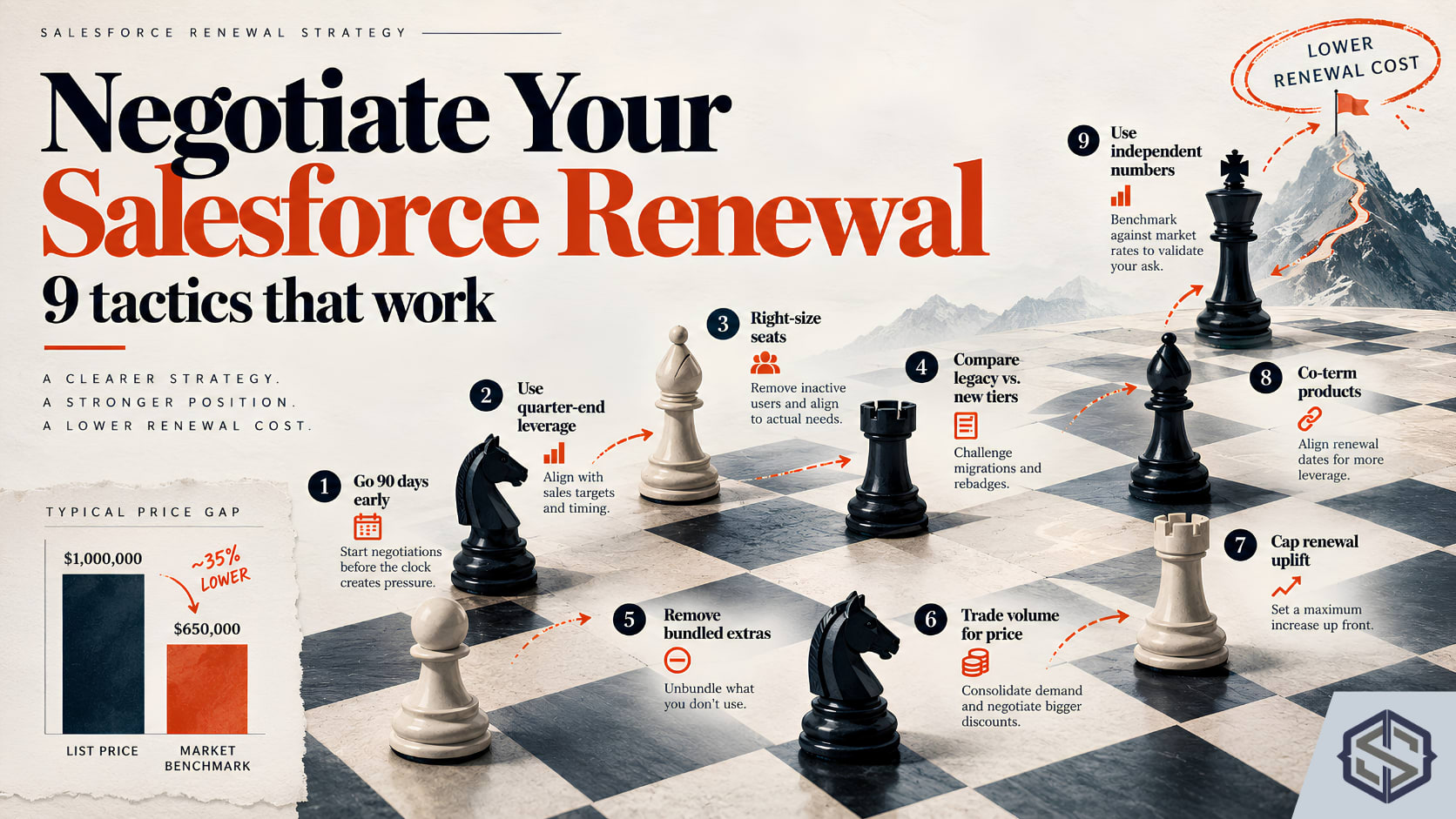
Nine tactics
1. Start 90 days early
Late conversations lose leverage. Ninety days leaves time to model alternatives and to ask for a better quote more than once.
2. Use the fiscal calendar
Salesforce's fiscal year ends on 31 January, with quarters ending 30 April, 31 July, 31 October and 31 January. Sales teams care most about closing before a quarter or year ends. A decision date a few days before one is a natural deadline. With the third quarter ending on 31 October 2026, anyone renewing in the next few weeks has a deadline to work with.
3. Right-size before you renew
Count real logins and feature use. Seats that nobody has opened in six months are money. Renewals are the only point where it is easy to reduce, so audit users first. Our free Who Sees What app shows exactly what each user can reach, which makes it easier to right-size permissions and licence types at the same time.
4. Price the new editions against legacy
For 50 users, Enterprise at $175 is $105,000 at list, and with Premier Success at about 30% it is $136,500. Core at $195 is $117,000 with Premier, Slack, Tableau Next and Agentforce credits bundled. The new tier may be cheaper, or it may not, but you should run both before choosing. We explain the tiers in Core vs Advanced vs Max.
5. Challenge bundled lines
If Slack, Tableau or Agentforce appear as extra lines on a bundled edition, ask for them to be removed. Check the sandbox entitlements too, as our hidden costs checklist explains.
6. Trade term and volume for price
Multi-year commitments and larger volumes move the discount. Make sure you can live with the commitment, and ask for the right to reduce counts at anniversaries.
7. Cap the uplift
A 6% yearly increase on a $93,600 subscription adds $5,616 in year two and $11,569 in year three, about $17,200 in total. A written cap or a fixed price for the term protects the number you negotiated.
8. Co-term and simplify
Align every product to a single renewal date so you have one negotiation, not four. Remove duplicate or unused add-ons while you are at it.
9. Bring independent numbers
A line-item estimate from an outside source turns vague unease into specific questions. It also tells you when a quote is fair, which is just as valuable.
Four things not to do
- Do not let the renewal date arrive as a surprise.
- Do not renew everything "as is" because the account executive says the price is fixed.
- Do not add products to get a bigger discount on ones you do not need.
- Do not treat the first discount as final.
A one-page preparation checklist
- Current licence count, real usage and idle seats.
- Edition, add-ons and what is bundled.
- Your target price from list and benchmark.
- The renewal date, quarter end and your decision deadline.
- Legacy against new-lineup comparison, all-in.
- Three terms to win besides price: cap, reduction rights, co-term.
If you want help with the preparation, bring your current order forms to a call and we will compare them with the estimator. Start with the express calculator to see your own gap.
Frequently asked questions
How much discount can I get on a Salesforce renewal?
It scales with size. On our contract data and market benchmarks, businesses under 50 users typically pay about 13% below list, 50 to 149 users about 20%, 150 to 499 users about 25% and very large deals 35% or more. Nonprofits typically see about 7%. Treat those as starting points, not promises.
When should I start negotiating my Salesforce renewal?
About 90 days before the renewal date, earlier for large contracts. That leaves time to model alternatives, run a competitive comparison and use the end of a Salesforce fiscal quarter as leverage. The next quarter ends on 31 October 2026 and the fiscal year ends on 31 January 2027.
Should I renew on legacy Enterprise or move to Core?
Price both with all costs included. Legacy editions add Premier Success at about 30% of net licences. Core includes it, plus Slack, Tableau Next and Agentforce credits. For 50 users, Enterprise with Premier is about $136,500 at list against $117,000 for Core.
Which Salesforce contract terms matter besides price?
A cap on renewal uplift, the right to reduce licence counts at renewal, co-terming of all products to one date, and clear terms for any usage-based products. A 6% yearly uplift costs about $17,000 over three years on a $93,600 subscription.
Can I use an outside estimate in a Salesforce renewal negotiation?
Yes. An independent line-item estimate shows whether an add-on is bundled, a sandbox is already included, or a licence count is padded. It turns "that seems high" into a specific question.
When does the Salesforce fiscal year end?
The Salesforce fiscal year ends on 31 January, with quarters ending on 30 April, 31 July, 31 October and 31 January. Sales teams care most about closing deals before a quarter or year ends, which makes those dates useful deadlines in a renewal.
Prices in this article are Salesforce list prices in US dollars, per user per month billed annually unless stated, as verified on 29 September 2026. Salesforce changes pricing, so confirm with Salesforce before you sign. Figures marked "estimator" come from the TwinStack Cost Estimator and are estimates, not quotes.
Know the gap before you negotiate
The estimator shows list price, benchmark price and the difference. Bring that number to the table.